

Harvard, Yale, MIT and Other Top Universities Under Federal Scrutiny: What Parents Should Know When Building a College List

Nine universities are under investigation over J-1 research visas, the EEOC is asking a court to enforce a subpoena against Harvard, and courts are refereeing related fights. Here is how to read the headlines without overreacting when you build your college list.
By Dr. Nathan Hurwitz · Hurwitz Consulting · October 9, 2026
QUICK ANSWERS
Should we drop Harvard, or any named school, from our college list? Not because of a headline alone. These are allegations and legal disputes, not findings.
Does the J-1 investigation affect international undergraduates? It is mainly about the research workforce. Most international degree-seeking students hold F-1 visas.
What should we do? Ask departments how undergraduate research is funded, and keep your college list anchored to fit, cost, and programs.
If your student is applying to top colleges, especially Ivy League schools and other research universities, you have likely seen alarming headlines: federal officials investigating nine universities over research visas, and a federal agency taking Harvard to court over hiring records. It is natural to ask whether this should change your college list or how you choose a college.
Our short answer is: not by itself. Below we explain what is happening, how to tell an allegation from a finding, and which questions are actually worth asking about undergraduate research and funding. Think of it as a guide to how to choose a college when the news is noisy.
What is the J-1 visa investigation, and which universities are named?
Vice President JD Vance, who chairs the administration’s fraud task force, announced that nine universities are under investigation for allegedly misusing the J-1 exchange-visitor program to bring in foreign workers who undercut American wages. The universities named are Arizona State, Brown, Harvard, Yale, Stanford, Caltech, MIT, UC Davis, and the University of Pittsburgh.
The Labor Department’s inspector general, Anthony D’Esposito, is leading the probe and says it will examine whether visa abuse, foreign influence, or improper financial relationships are compromising federally funded research. Subpoenas have been served. Brown said its subpoena seeks records on federal foreign-labor programs, and MIT described its own as “very broad.”
A quick translation: the J-1 is an exchange-visitor visa used for researchers, visiting scholars, and other exchange participants. It is different from the F-1 visa that most international degree-seeking students hold. This investigation is mainly about the research workforce, not about undergraduate admissions.
Are the J-1 allegations proven? Claims versus findings
Vance cited J-1 use on federally funded grants at about 61 percent at the named universities versus 38 percent nationally, and claimed that American graduate students or researchers earn roughly $20,000 more than J-1 holders. Those are officials’ claims. No findings of wrongdoing have been made.
The universities have responded. Stanford says it complies with all applicable visa laws and will cooperate. Arizona State says it follows U.S. policy and law. Brown says its international scholars make essential contributions and that it will respond promptly. MIT notes that the government vets each J-1 holder. The honest summary is that these are serious allegations from officials, and they are untested.

Figure 1. The central claim in the J-1 probe, as stated by officials. These are claims, not findings.
What is the EEOC’s subpoena fight with Harvard about?
On a parallel track, the EEOC asked a federal court on Sept. 29 to enforce a subpoena against Harvard. The agency is investigating whether Harvard’s faculty-diversity goals amount to race and sex discrimination in hiring, based on a charge filed by EEOC Chair Andrea Lucas in April 2025. It is seeking hundreds of documents, including hiring-committee guidance since 2018, minutes and agendas from diversity offices, and records on a diversity fellowship program.
Harvard says the subpoena contains more than 700 requests, that it has already produced more than 9,000 pages, and that it offered 68 days of meet-and-confer discussions. It calls the demand a “fishing expedition” and argues the investigation is retaliatory. This is the latest chapter in a long-running dispute between Harvard and the administration that we have followed in earlier editions.
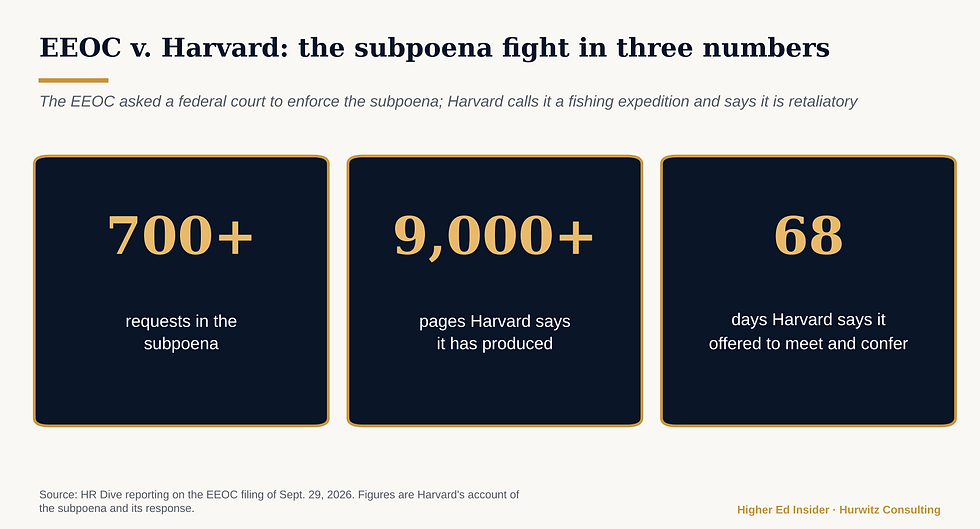
Figure 2. The subpoena fight in three numbers, as described by Harvard.
What are courts saying? The in-state tuition rulings
A related story shows why the final word is rarely the first headline. In a ruling reported Oct. 8, a federal judge dismissed the Justice Department’s challenge to Virginia’s in-state tuition laws for undocumented students. It was the second such dismissal, after Minnesota, which DOJ has appealed. DOJ has sued 24 states and D.C., and judges sided with DOJ in six: Illinois, Kansas, Kentucky, Nebraska, Oklahoma, and Texas.
That tuition dispute is a different issue from the J-1 probe or the Harvard subpoena. We include it because it illustrates a pattern: federal actions are being tested in court, with mixed results, and outcomes take time.

Figure 3. The in-state tuition lawsuits illustrate that federal actions are being tested in court with mixed results.
How should parents read these headlines when choosing a college? (Our analysis)
We suggest asking three questions of any headline in this category.
• Is it an allegation or a finding? Most of what we are seeing is at the investigation or litigation stage. Timelines are measured in months or years, not days.
• Does it affect the institution or the student? We have not seen evidence that these actions change undergraduate admissions or aid this year. Indirect effects are possible: research funding, lab staffing, graduate stipends, and the administrative attention these fights consume.
• Why these names? Elite universities hold large amounts of federal research funding and draw the most press attention, which is one reason they appear in headlines most often. That does not mean other institutions are untouched by similar rules.
If your student is research-minded, the practical move is to ask departments directly how undergraduate research is funded and staffed. That tells you more about stability than any headline can.
The strongest arguments on each side
Supporters of aggressive oversight argue that federal research dollars warrant scrutiny of how labor is hired and paid, that wage undercutting hurts American graduate students and early-career researchers, and that transparency about foreign influence is a legitimate national-security interest.
Those urging caution point out that the headline figures are officials’ claims, that universities say each J-1 participant is vetted by the government, that broad subpoenas burden institutions and may chill international collaboration, and that similar enforcement efforts have met resistance in court.
DR. HURWITZ’S TAKE
For families, the practical effect is not on this year’s applicant pool; it is on the research enterprise that funds graduate stipends, undergraduate research slots, and lab opportunities at these schools. Two things can be true at once: oversight of federal research dollars is legitimate, and sweeping subpoenas can chill the international collaboration that drives research. If your student is headed toward a research-heavy major, do not rebuild your list around these headlines. Instead, ask each department directly how its labs are funded and whether undergraduates get real access, and remember that allegations are not findings.
Dos and Don’ts
Do
• Read each university’s own public statement rather than relying on social-media summaries.
• Ask departments how undergraduate research is funded and how many undergraduates take part.
• Build your list on fit, cost, and programs, which don’t change with the news cycle.
• Note real milestones, such as court dates and subpoena response deadlines, as the actual news.
• Talk with your student about the difference between an allegation and a finding.
Don’t
• Don’t add or drop a school solely because of a headline.
• Don’t repeat unverified figures as established facts.
• Don’t assume the J-1 story means F-1 student visas are affected.
• Don’t assume a famous name means a school is either immune or in trouble.
• Don’t ignore genuinely relevant questions if your student’s field depends heavily on federal grants. Just ask.
Your Action Steps (and Why Each One Matters)
1. Ask each department how undergraduate research is funded and staffed.
Why: Federal grants fund a great deal of university research. Asking directly shows how exposed a lab or program is, without guessing from headlines, and it is exactly the kind of question admissions and faculty are used to answering.
2. Read each university’s official response.
Why: Primary statements tell you what the institution is actually doing, such as cooperating, challenging, or negotiating, which is more informative than commentary about it.
3. Keep your list anchored to fit, cost, and outcomes.
Why: A list built on durable criteria will not need to be rebuilt every news cycle. Headlines are a reason to ask questions, not a reason to change a plan.
4. International families: learn the difference between J-1 and F-1.
Why: Most international undergraduates hold F-1 visas. Confirming your category with the international office replaces fear based on confusion with an accurate picture of what applies to you.
5. Check for updates monthly, not daily.
Why: Investigations and lawsuits move slowly. Checking too often feeds anxiety without adding information, and monthly is usually enough to catch real developments.
6. Write a one-paragraph “what we know / what we don’t” with your student.
Why: It models careful reading, which colleges value, and it helps your student talk about current events thoughtfully in essays and interviews.
What We Don’t Know Yet
• The full scope of the J-1 subpoenas and whether any findings will result.
• Whether additional universities will be named.
• How the court will rule on the EEOC’s request to enforce its subpoena against Harvard.
• How the appeals in the in-state tuition cases will be resolved.
Frequently Asked Questions
Are Ivy League schools being investigated?
Three of the nine universities named in the J-1 investigation, Brown, Harvard, and Yale, are Ivy League members. The others are Arizona State, Stanford, Caltech, MIT, UC Davis, and the University of Pittsburgh. Harvard also faces the separate EEOC subpoena dispute. These are allegations, not findings.
Should I remove Harvard or another named school from my college list?
Not because of a headline alone. Build your college list on fit, cost, and programs. If your student’s field depends on federal research grants, ask the department how its labs are funded and whether undergraduates get real access.
Does the J-1 investigation affect international students applying as undergraduates?
The J-1 is an exchange-visitor visa used for researchers and visiting scholars. Most international degree-seeking undergraduates hold F-1 visas, so the investigation is mainly about the research workforce. Confirm your visa category with the college’s international student office.
How can I find out whether a college offers undergraduate research?
Ask admissions and individual departments how many undergraduates take part in research, how projects are funded, and whether students earn pay or credit. Those answers tell you more than a college’s reputation does.
Will these investigations change college admissions or financial aid this year?
We have not seen evidence that they change undergraduate admissions or financial aid decisions for this cycle. Indirect effects on research funding and staffing are possible, which is why asking departments directly is worthwhile.
THE BOTTOM LINE
These are headline-grabbing, high-stakes disputes, but at this stage they are allegations, subpoenas, and court filings, not verdicts. Keep your list tied to fit and cost, ask departments real questions, and let the facts arrive before you change course.
Ready for a Plan for Your Student?
Book a 60-minute College Readiness Assessment ($225): schedule here. Or start with the free Parent Starter Kit. Want more like this? Subscribe to Higher Ed Insider (free).
Questions? hurwitzadmissions.com · nathan@hurwitzadmissions.com · (203) 613-9262
Sources
This post is general information, not legal or financial advice. Allegations and proposals are labeled as such; check primary sources for the latest.

Comments