

A Court Pauses the End of "Duration of Status": What International Students and H-1B Families Need to Know

A nationwide injunction keeps international students' long-standing protections in place while the case proceeds, but a separate DHS proposal targets the grace period for H-1B families. An injunction is a pause, not a verdict.
By Dr. Nathan Hurwitz · Higher Ed Insider, Edition 2026-23 · International Students · About 8 minutes
New here? Get every edition of Higher Ed Insider free: Subscribe
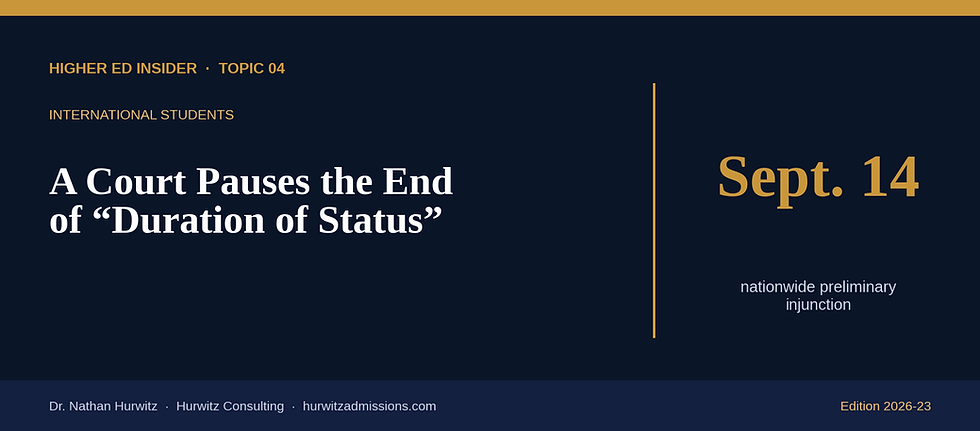
On September 14, 2026, a federal judge issued a nationwide preliminary injunction blocking the end of duration of status.
One day before it was set to take effect, a federal judge in Massachusetts stopped one of the most consequential changes to international student policy in decades. On September 14, U.S. District Judge F. Dennis Saylor IV issued a nationwide preliminary injunction blocking a Department of Homeland Security rule that would have ended "duration of status" for F-1 students and J-1 exchange visitors.
For families that had been bracing for September 15, the ruling brought relief. But the relief is temporary, and a second DHS proposal affects a different group of families altogether. This post explains both rules in plain language, why the court acted, what remains uncertain, and how families with very different circumstances can plan. As always, this is general information, not legal advice, and families with specific immigration questions should consult a qualified immigration attorney.
What "duration of status" has meant
For roughly four decades, international students on F-1 visas and exchange visitors on J-1 visas have been admitted to the United States for "duration of status." Instead of an expiration date on a student's record, the form says "D/S," and the student may remain as long as they continue to be enrolled full time and follow the rules of their status. The arrangement lets students finish a degree without repeatedly asking the government for permission to stay, and it gives them flexibility when a program runs longer than expected, when a student changes majors, or when a student transfers.
What the rule would have done
The rule, published on July 17, would have replaced that open-ended admission with fixed periods of no more than four years. It also would have restricted transfers and changes of major or degree level, required students who needed more time to apply to USCIS for an extension of stay, and cut the F-1 post-completion grace period from 60 days to 30. Legal analysts estimated that the rule would have affected roughly 1.2 million international students.
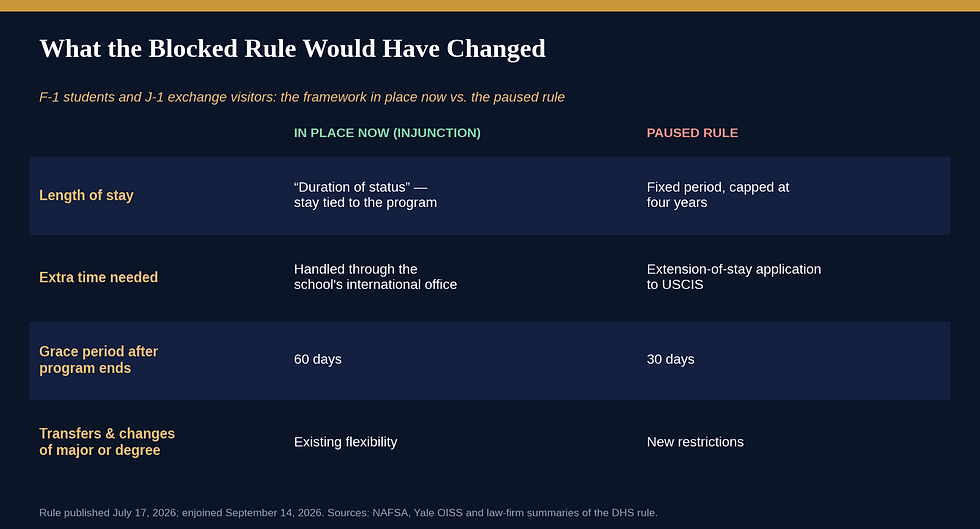
A side-by-side comparison of the framework now in place and the paused rule.
To see why that matters, consider a student in a five-year engineering program, or a doctoral student whose research timeline is unpredictable, or a student who discovers a stronger fit in a different field in the second year. Under the paused rule, each would have faced new paperwork, new deadlines, and new risk. Under the rule that remains in place, they continue as before.
Why the court stepped in
In a 48-page order, Judge Saylor found that the plaintiffs, a coalition that includes NAFSA: Association of International Educators, the Presidents' Alliance on Higher Education and Immigration, the Association of Independent Colleges and Universities in Massachusetts, and several labor unions, were likely to succeed on claims that DHS violated the Administrative Procedure Act. Among the concerns was that the agency did not respond adequately to the roughly 22,000 public comments it received, most of them opposed.
It is important to understand what the order does and does not do. A preliminary injunction does not strike down the rule. It prevents the rule from taking effect while the lawsuit continues. Students continue to be admitted for duration of status, and the earlier regulations on travel, work authorization, program changes, and extensions remain in force. Colleges' international offices have been telling students exactly that.
A status conference in the case was set for October 2, and the government is widely expected to appeal. Anyone expecting a permanent resolution this month will be disappointed.
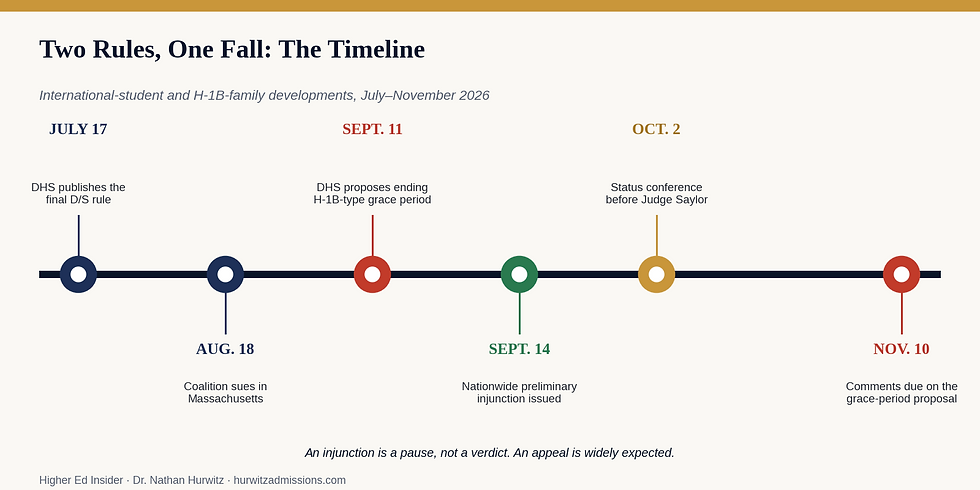
The timeline of both rules, from the July 17 publication through the November 10 comment deadline.
The second rule: a grace period for H-1B families
A separate proposal deserves attention from a different set of families. On September 11, DHS proposed eliminating the discretionary 60-day grace period for workers in H-1B, L-1, O-1, E, and TN status who lose their jobs. If finalized, a worker, along with that worker's spouse and children, would be considered out of status the day after employment ends. Comments are due November 10.
Why does this belong in a college admissions newsletter? Because many of the students I work with are the children of H-1B professionals. A family's immigration situation is rarely separate from a student's college plans, and a household that suddenly loses a 60-day cushion after a layoff has far less room to maneuver during the exact months when applications, deposits, and financial aid decisions are due.
This is a proposal, not a final rule. Proposals can change, be withdrawn, or be challenged. But families should understand what is being discussed and consider whether to submit a comment during the open period.
Different families, different questions
The effects of these rules vary by family, so it helps to think through the situations separately.
• International applicants planning to arrive in 2027. Many are deciding from abroad and cannot easily visit campuses. They should favor colleges with strong international student offices, a clear record of helping students through regulatory changes, and a reputation for finishing students on time.
• Current international students. For now, nothing in their status has changed. They should keep documentation current, stay in touch with their international student office, and avoid relying on social media rumors.
• U.S.-educated seniors whose parents hold H-1B visas. These students should have a frank conversation with their parents about what would happen to the family's status if a job changed during senior year, and should ask each college how dependent-visa changes could affect aid and enrollment.
• Families with children on dependent status who are approaching age 21. These families already face separate, well-known challenges and should consult an attorney about their specific timelines.
• Domestic students and families. The rules also touch the campuses where domestic students study. Many colleges depend on international enrollment for diversity, research capacity, and tuition revenue, and policy uncertainty can ripple through programs, particularly in graduate and STEM fields.
Perspectives worth weighing
Reasonable people disagree about the policy underlying the rule. Supporters argue that open-ended admission makes it harder for the government to monitor compliance and that fixed periods with clear extension procedures would bring accountability to a system that has operated on trust. Critics, including most of the commenters, argue that the rule creates burdensome paperwork, uncertainty, and risk for students who are following the rules, and that it would push talented students to other countries. One legal summary of the rulemaking record noted survey data in which up to 47 percent of currently enrolled international students said they would not have originally come to the United States under such a rule.
The court's ruling does not resolve this debate. It speaks to whether the agency followed the process the law requires. If the government appeals or issues a revised rule, the debate will continue, and families should expect continued change in the months ahead.
What families can do now
Uncertainty is stressful, and it is tempting either to panic or to dismiss it. A calmer approach is to prepare.
First, build a document file: passports, I-20s or DS-2019s, I-94 records, and notices from the college. Second, make a point of reading messages from the international student office; these offices have been among the best sources of accurate guidance. Third, if a parent's visa status is tied to employment, have a contingency plan for the student's senior year, and consider a one-hour consultation with an immigration attorney. That is inexpensive insurance compared with the cost of an unplanned gap.
Fourth, put dates on a calendar. The October 2 status conference matters because any developments could change the guidance. The November 10 comment deadline matters because it is the moment when affected families can make their voices part of the record.
What colleges are saying and doing
One of the more reassuring features of this episode has been the behavior of colleges themselves. International student offices have been among the most responsive and candid sources of guidance, issuing plain-language updates for students, scholars, and dependents as the ruling came down. Institutions that belong to the groups that sued, as many do, have been open about the stakes.
For applicants, that gives you something concrete to evaluate. When you contact an international office, notice how quickly it responds, whether it answers specific questions, and whether it provides written guidance. A college that handles uncertainty well in September is likely to handle it well in a year when something else changes. That is not a rankings metric, but it may be one of the most valuable things you can learn about a school before you commit.
Questions I am hearing from families
"Does the injunction mean everything is back to normal?" For now, the existing duration-of-status framework applies to current and new students, and the rule's restrictions on transfers and changes of educational objective are not in effect. But a preliminary injunction can be appealed or modified, so "normal" is a temporary condition.
"Should international applicants wait to see how this resolves?" I would not make a decision to skip an application on the basis of a case that is still moving. Applying keeps options open, and the decision to enroll comes months later, when more may be known. Meanwhile, favor colleges that communicate clearly and have a record of supporting students through regulatory change.
"If a parent is on an H-1B visa, does the grace-period proposal affect us now?" It is a proposal, not a final rule, so it does not change anything today. But it is worth planning as if a change is possible, and consulting an attorney about your family's specific circumstances.
"Is it worth submitting a public comment?" Public comments are part of the record agencies must consider, and in this very case the volume and content of comments figured in the court's reasoning. If you or your family are affected, a short, factual, personal comment can matter.
Dr. Hurwitz's Take
An injunction is a pause, not a verdict, and families should plan accordingly. International applicants should not panic, but they should favor colleges with strong international student offices, clear graduation timelines, and a record of finishing students in four years. For H-1B families with a U.S.-educated senior, the grace-period proposal is a reason to talk now about what happens to the student's status if a parent's job changes mid-application, and to ask each college how dependent-visa changes affect aid and enrollment. When in doubt, a one-hour consultation with an immigration attorney is inexpensive insurance.
Your action checklist
• International applicants: review each college's international student office guidance.
• Prioritize programs with strong four-year graduation rates.
• H-1B families: discuss a contingency plan for the student's status during senior year.
• Assemble a file of immigration and enrollment documents and keep it current.
• Watch for developments after the October 2 status conference.
• Consider submitting a comment on the grace-period proposal before November 10.
Key sources
Is your student on track for this admissions cycle?
Book a College Readiness Assessment, a focused 60-minute session ($225) covering your student’s list, early strategy, testing, and financial aid timeline.
Watch. Read. Follow.
• Watch on YouTube: @HurwitzAdmissions
• Read the blog: hurwitzadmissions.com/blog
• Follow on Facebook: Hurwitz Admissions
• Follow on Instagram: @hurwitzadmissions
Dr. Nathan Hurwitz · Hurwitz Consulting · hurwitzadmissions.com · nathan@hurwitzadmissions.com · (203) 613-9262
This article provides general information and analysis, not legal, immigration, or financial advice. Families with specific questions should consult a qualified professional. © 2026 Hurwitz Consulting.


Comments